You dimmed the lights an hour ago, left your phone in another room, and kept the bedroom cool. Yet the moment your head hits the pillow, your jaw is still clenched, your shoulders are hovering half an inch off the mattress, and your mind starts running tomorrow’s checklist on a loop. When you are wide awake at 2:00 AM wondering why can’t I fall a sleep, the problem is rarely a lack of discipline or sleep hygiene.
You are not broken. Your nervous system simply has not received a credible physical signal that it is safe to power down.
That gap between mental exhaustion and physical alertness is exactly why sound bed therapy has moved out of clinical rehabilitation labs and into modern recovery studios. Built on the principles of vibroacoustic therapy, a dedicated sound bed uses targeted low-frequency vibration and synchronized audio to give a wired body a bottom-up off-switch helping you downshift physically before you ever try to force sleep.
What Is Sound Bed Therapy? (The Science of Vibroacoustic Therapy)
Sound bed therapy is a form of vibroacoustic therapy in which you lie on a specialized lounge embedded with tactile transducers that convert low-frequency sound waves (30–120 Hz) into gentle, full-body physical vibrations. Synchronized with audio through headphones, it engages both hearing and touch to calm nervous system hyperarousal and release muscle guarding.
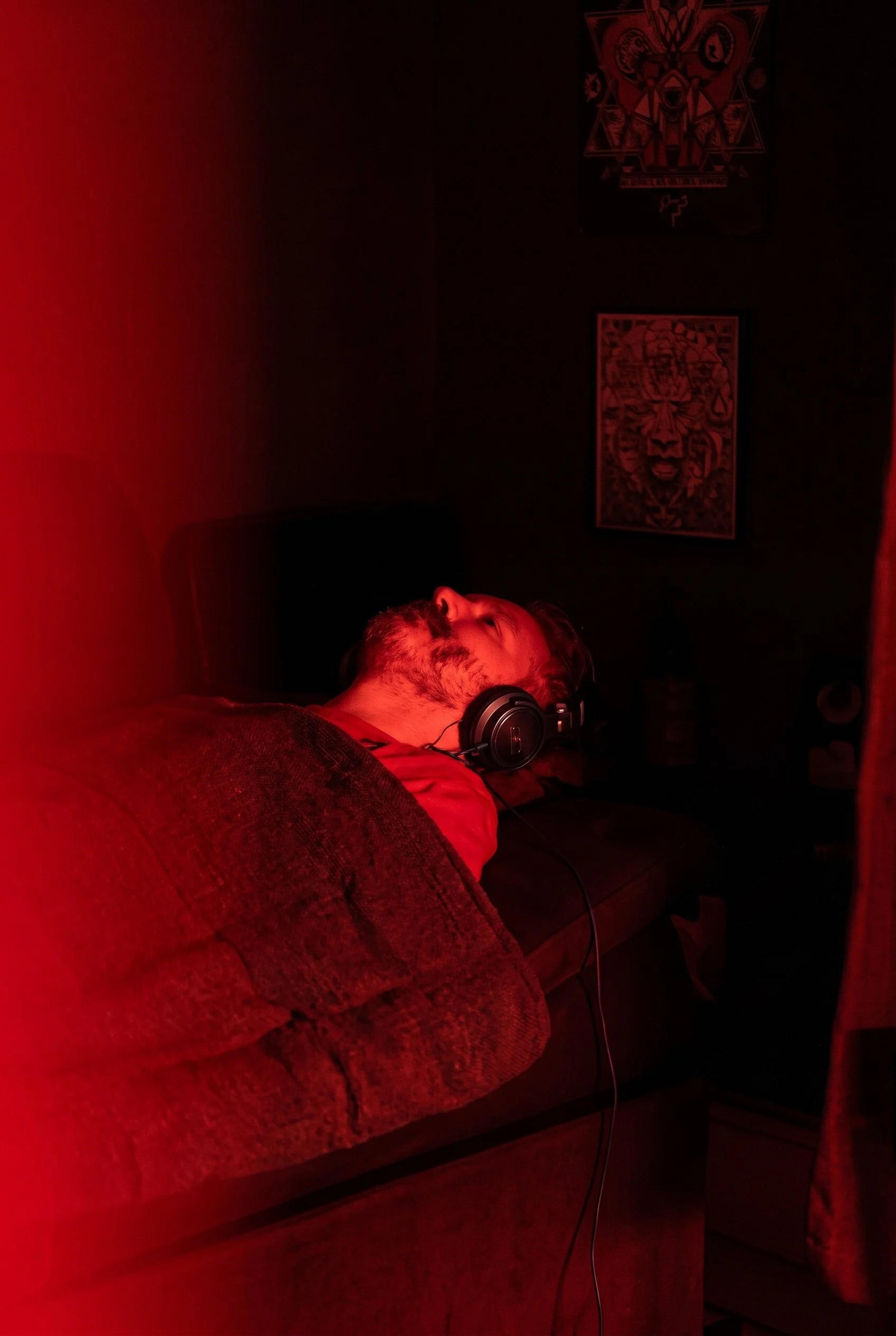
To understand why a sound bed feels so different from simply putting on relaxing music, it helps to look at the mechanism underneath it. Vibroacoustic therapy uses low-frequency sound delivered through a specialized lounge so the body feels the frequency, not just hears it. At True You Collective, the sound lounge is the core of the Sleep Support protocol: vibration quiets sympathetic drive, reduces muscle guarding, and helps the nervous system shift toward rest before sleep is supposed to happen.
Most relaxation tools rely on a single sensory pathway your ears. You listen to a guided meditation, ambient rain, or a playlist and hope your brain convinces your body to let go. When you are deeply stressed or stuck in "tired but wired" hyperarousal, that top-down approach often stalls because your musculoskeletal system is still broadcasting tension signals back up to the brain.
A vibroacoustic sound bed engages two sensory pathways at the exact same time:
Auditory Input: Over-ear headphones deliver curated, slow-tempo acoustic compositions and harmonic frequencies that occupy the auditory cortex and interrupt repetitive mental chatter.
Tactile Mechanical Input: Embedded low-frequency transducers specialized audio drivers engineered to transfer mechanical waves rather than push air send gentle, rhythmic vibrations directly through the cushion into your spine, musculature, and connective tissue.
Inside your skin, fascia, and deeper muscle layers sit specialized mechanoreceptors, including Pacinian corpuscles, which are tuned to detect low-frequency vibration. As documented in clinical reviews of low-frequency sound stimulation indexed by PubMed Central (National Institutes of Health), rhythmic vibrations most frequently centered around 40 Hz in therapeutic protocols relay steady, predictable sensory feedback to the nervous system. Instead of staying braced for threat, the autonomic nervous system begins shifting out of sympathetic fight-or-flight dominance and toward parasympathetic rest-and-digest mode. Heart rate slows, respiratory depth increases, and the body stops fighting stillness.
Why People Call It "Vibroacoustic Massage Therapy" and How It Differs from Mechanical Massage
Physical Massage vs. Vibroacoustic Resonance
- Motorized Physical Force Rollers and percussion heads press into outer tissue.
- Surface Spot-Treatment Kneads localized muscle knots with physical friction.
- Triggers Muscle Guarding Deep pressure can cause a flinch reflex and alertness.
- Zero Downward Pressure Transducers emit smooth 30–120 Hz sine waves with no friction.
- Deep Tissue Reach Sound waves travel through fluid-rich tissue without bracing.
- Systemic Nervous Reset Coherent rhythm signals safety and releases global tension.
Vibroacoustic massage therapy uses acoustic transducers to send smooth, low-frequency sound waves deep into tissue without physical pressure. Traditional mechanical massage beds use motorized rollers or percussion heads to knead surface muscles, which can feel stimulating rather than sedating right before sleep.
Because the physical sensation of lying on an active sound bed feels like warm, rolling waves moving through your back, hips, and legs, first-time clients frequently refer to it as vibroacoustic massage therapy. While the description makes intuitive sense, the underlying physics and the effect on your nervous system are completely different from a mechanical massage chair, roller table, or percussive massage gun.
Mechanical massage devices rely on physical force. Rollers press into paraspinal muscles, air bladders squeeze calves, and percussion heads strike tissue dozens of times per second. During the afternoon or immediately after a heavy workout, that mechanical pressure can feel great for breaking up localized stiffness. Right before bed, however, forceful kneading or rapid percussion can actually trigger subtle protective muscle guarding or stimulate the sympathetic nervous system, leaving you feeling alert rather than sleepy.
A vibroacoustic sound bed applies zero physical pressure or friction:
No Mechanical Motors: Instead of spinning gears or thumping heads, acoustic transducers translate pure sine-wave frequencies into smooth physical resonance.
Deep Tissue Reach Without Bracing: Because sound waves travel efficiently through fluid-rich human tissue, low frequencies reach deep postural muscles along the spine, pelvic floor, jaw, and diaphragm without triggering the flinch reflex that deep-tissue pressure sometimes causes.
Systemic Rhythm Over Local Spot-Treatment: Rather than working on one knot at a time, the entire body receives a coherent, rhythmic wave pattern that encourages global muscular release.
For people who hold chronic, unconscious tension clenching their molars at night, hiking their shoulders toward their ears at a desk, or bracing their lower back this passive, non-invasive release lets tight tissue soften without asking the body to tolerate discomfort first.
Clinical Vibroacoustic Sound Bed vs. At-Home Vibroacoustic Mats and Sound Therapy Devices
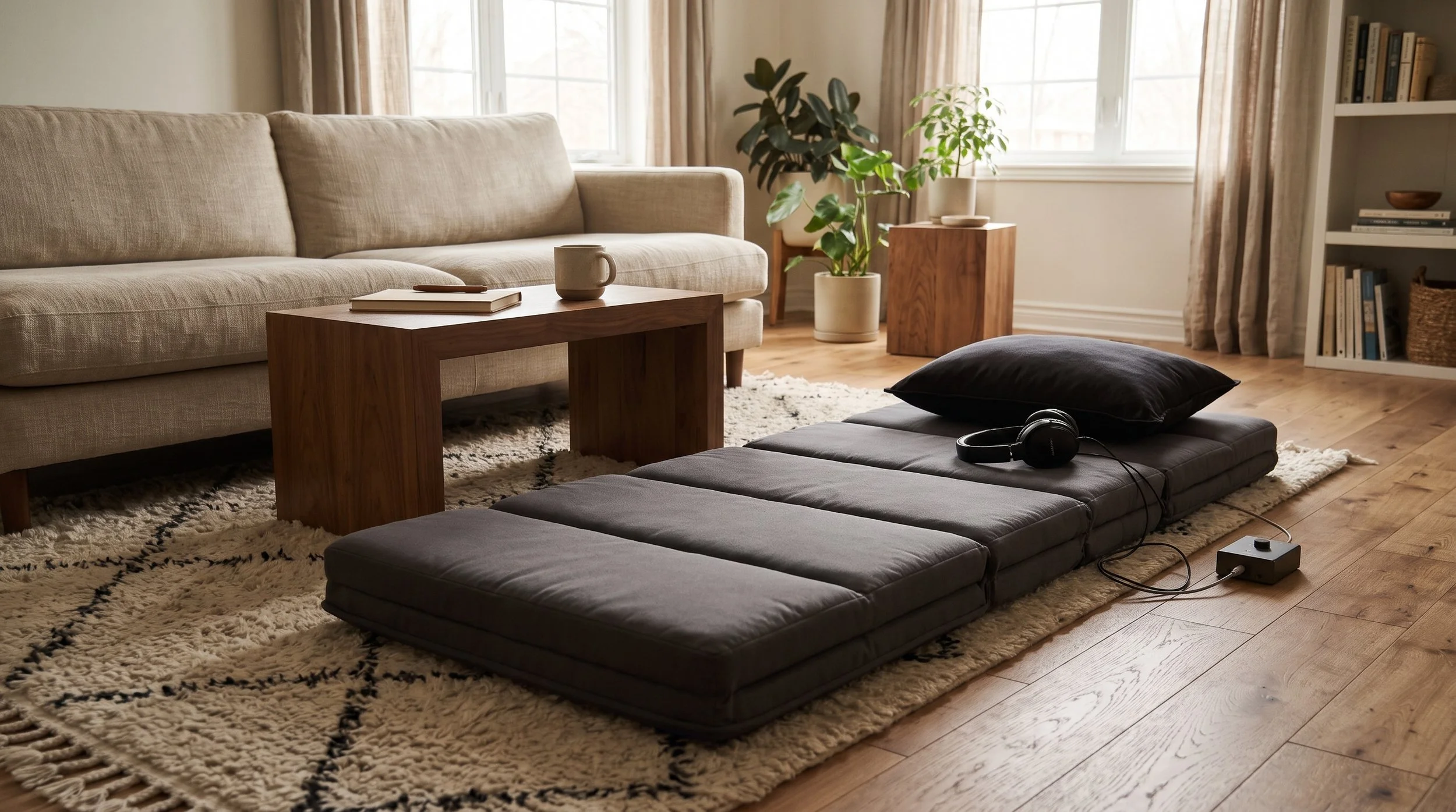
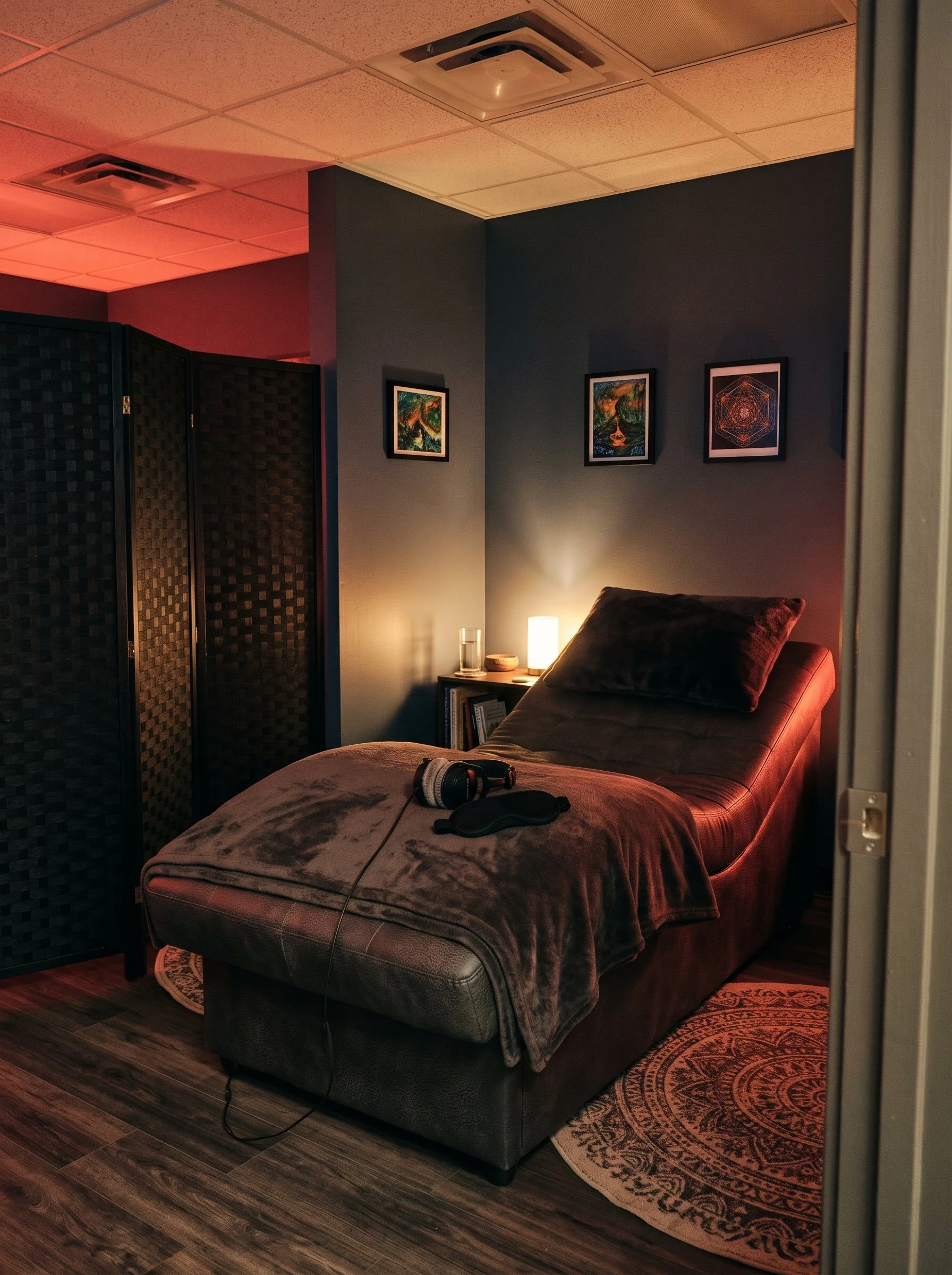
A clinical vibroacoustic sound bed uses high-output, multi-point transducers mounted inside an acoustically engineered frame to deliver even, full-spine frequency transfer. At-home vibroacoustic mats use smaller, portable motors with lower power density, making them useful for daily maintenance but noticeably weaker for deep somatic downshifting.
Once people experience how effectively vibration settles a racing body, the next logical question is whether they need to visit a studio or if they can buy a gadget for their bedroom. The market for sound therapy devices has expanded rapidly, ranging from sleep headbands to foldable pads. Each tier has a legitimate place, provided you match the hardware to what you actually expect it to do.
| Hardware Tier | Common Examples | How It Delivers Input | Best Use Case | Primary Limitation for Sleep |
|---|---|---|---|---|
| Audio-Only Sound Therapy Devices | Binaural beat apps, sleep headbands, bone-conduction pillows | Airborne or skull-conducted audio only (auditory pathway) | Masking bedroom noise; mild cognitive distraction | Zero somatic or tactile input; does not release physical muscle guarding |
| Consumer Vibroacoustic Mats & Cushions | Portable foam pads, chair toppers, wearable tactile buzzers | Small, low-wattage transducers or basic vibration motors | Daily at-home maintenance between studio sessions | Lower frequency depth, uneven spine contact, setup and storage friction at bedtime |
| Clinical Vibroacoustic Sound Bed | Studio sound lounges with multi-point high-output transducers | Synchronized full-body tactile resonance (30–120 Hz) + isolated audio | Deep autonomic downshift for wired, high-stress sleepers | Requires an in-studio visit; not a portable home gadget |
Where At-Home Devices Help—and Where They Fall Short
Audio-only sound therapy devices are inexpensive and convenient. If your only hurdle at night is street noise outside or mild mental restlessness, listening to low-frequency ambient tracks through a comfortable sleep headband can provide a helpful cue for bed. What audio alone cannot do is reach into braced muscles or mechanically stimulate deep tissue receptors.
An at-home vibroacoustic mat bridges part of that gap by placing compact transducers inside a portable cushion you can lay over a yoga mat or bed. For daily maintenance between studio sessions, a well-built mat can be a solid addition to an evening routine. However, consumer mats face clear engineering trade-offs:
Transducer Power and Frequency Accuracy: Portable mats rely on smaller, lower-wattage drivers that often lose clarity below 50 Hz—the exact sub-bass band where full-body somatic resonance feels most grounding.
Surface Density and Contact: If a thin mat sits on top of a soft memory-foam mattress, the mattress absorbs half the vibration before it ever reaches your spine. Conversely, lying on a thin pad over a hard floor creates pressure points that keep your hips and shoulders from fully letting go.
Bedtime Friction: Pulling out a mat, plugging in power cables, untangling headphones, and rolling everything back up when you are already exhausted adds steps right when you need effortless rest.
A purpose-built clinical vibroacoustic sound bed eliminates those compromises. High-output transducers are mounted directly into an acoustically tuned, ergonomically contoured lounge that supports the spine in neutral alignment, ensuring even frequency transfer from the base of the skull down to the heels.
At-Home Mat Trade-Offs vs. Clinical Sound Bed
What Happens During a Sound Bed Therapy Session
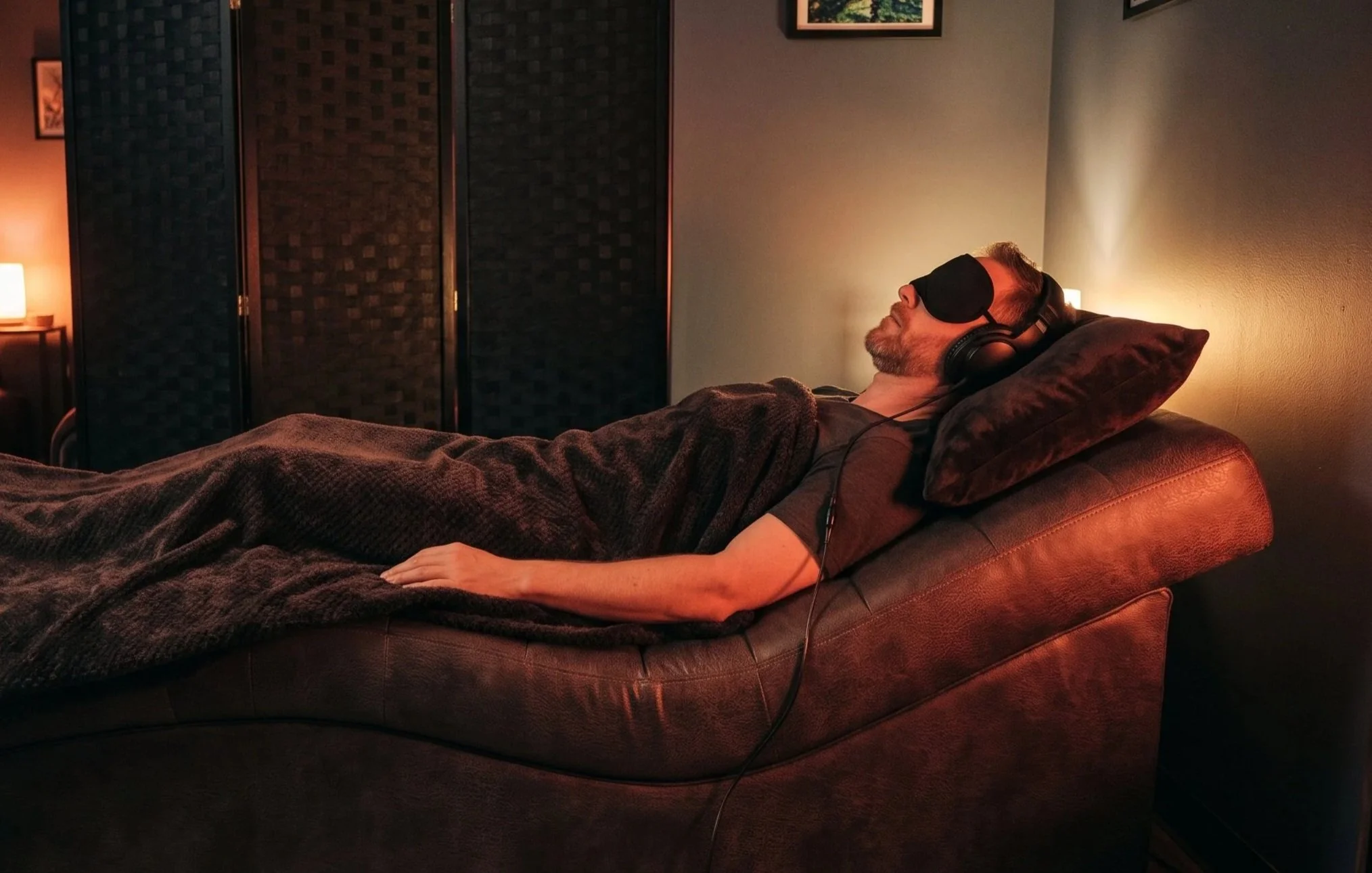
Stepping onto a sound bed for the first time requires zero preparation, special breathing skills, or prior experience with meditation. You remain fully clothed, lie back onto the contoured lounge, place a light-blocking eye mask over your eyes, and put on studio headphones.
Once the track begins, you hear warm, layered acoustic tones while a subtle, wave-like hum rises through the surface beneath your back. The vibration is never jarring or sharp; it feels closer to the steady, rhythmic purr of a smoothly moving train or a deep musical cello resonating right beneath your ribs. Because the physical sensation gives your brain a clear, continuous anchor in the present moment, you do not have to fight your thoughts or "try" to clear your mind.
The timing of that downshift matters. Most people wait until 11:00 PM when they are already under the covers and frustrated to ask their nervous system to decelerate from 60 mph to zero. If you are desperately searching for answers on how to sleep quickly, the secret is often completing a sound bed therapy session earlier in the day or evening. By doing so, you discharge accumulated sympathetic tension before you enter the bedroom. Instead of spending the first two hours of the night burning off cortisol in the dark, your body enters bed already primed for sleep onset and restorative slow-wave cycles.

The True You Collective Approach
Expert Opinion: Why Bottom-Up Somatic Regulation Matters for Sleep
When high-functioning adults struggle to sleep, they almost always try to solve the problem cognitively—tracking metrics, reading sleep books, or forcing themselves to lie still while their heart rate stays elevated. According to Sicadia-Paige, Certified Vibroacoustic Therapy Practitioner at True You Collective, trying to think your way out of physiological hyperarousal rarely works because the body has to feel safe before the brain allows deep sleep stages to unfold.
"Across more than 500 nervous system reboots at our Arvada studio, the physical shift on the sound lounge follows a remarkably consistent arc," "During the first 5 to 8 minutes, wired professionals and stressed parents usually arrive with shallow upper-chest breathing, tight jaw muscles, and subtle hip or ankle tension their bodies are still holding the posture of a demanding workday. Around the 10- to 15-minute mark, the low-frequency pulse softens that muscular guarding. You can visibly see their shoulders drop into the cushion, their swallow reflex slow down, and their breathing shift into long, effortless diaphragmatic cycles. Many clients share in their reviews that the biggest surprise isn't just how calm they feel walking out—it's how quickly they drop into sound sleep that night without tossing and turning."Emerging clinical research aligns with these somatic observations. In a randomized, waitlist-controlled neuroimaging study of adults with insomnia indexed by the National Library of Medicine (PubMed), participants who received combined vibratory and auditory stimulation over one month demonstrated measurable increases in total sleep minutes, lower Insomnia Severity Index scores, and significant changes in functional brain connectivity across regions governing sensory integration and arousal regulation. While larger clinical trials are still ongoing, early evidence and real-world studio outcomes both point to the same conclusion: giving the nervous system a structured physical rhythm makes downshifting dramatically easier than willpower alone.
About the practitioner
Sicadia-Paige is the founder of True You Collective and a certified vibroacoustic therapy practitioner. The Arvada studio has completed 500+ nervous system reboot sessions and holds a strong local review record, with clients frequently describing easier sleep, reduced tension, and a clearer sense of regulation after working with the protocol. The work is body-first and drug-free. It is not a sleep study, not CBT-I, and not apnea care.
How True You Collective Pairs the Sound Lounge with Light and Heat in Arvada
While a standalone vibroacoustic sound bed session provides a deep nervous system reset on its own, chronic sleep disruption rarely stems from a single bottleneck. Most wired sleepers are dealing with three overlapping physiological roadblocks at once: sympathetic hyperarousal, disrupted circadian light signaling, and a core body temperature that stays too warm late into the evening.
At True You Collective in Arvada, our approach to holistic wellness therapy stacks targeted, drug-free inputs in a deliberate sequence rather than asking you to guess which single tool might work. Inside our Sleep Support protocol, vibroacoustic therapy serves as the primary downshift anchor, paired with full-body red light therapy to avoid melatonin-suppressing glare and infrared sauna sessions to encourage the post-heat core temperature drop your brain relies on to initiate deep sleep.
Shifting from mental effort to physical regulation is often the missing piece. Many clients fall asleep faster and sleep more soundly after their very first session, while lasting circadian and autonomic recalibration builds progressively across 4 to 6 weeks of weekly visits. When you are ready to experience the sound lounge in person, you can book an $88 first session in our Arvada Sleep Support protocol.
Pre-Booking Sound Bed Safety Screener
Review the clinical exclusions below before scheduling a vibroacoustic therapy session.
Safety, Contraindications & Who This Is Not For
Sound bed therapy is gentle, non-invasive, and well-tolerated by most adults, but low-frequency mechanical vibration is not appropriate for every medical profile. Please consult your healthcare provider or avoid vibroacoustic sessions if you have any of the following conditions:
Implanted Electronic Medical Devices: Pacemakers, implantable cardioverter-defibrillators (ICDs), deep-brain stimulators, or insulin pumps that could be affected by electromagnetic or mechanical vibration.
Pregnancy: Specifically during the first trimester, or at any stage without explicit clearance from your obstetrician.
Acute Vascular or Cardiovascular Conditions: Active deep-vein thrombosis (DVT), recent blood clots, severe uncontrolled hypotension, or unstable heart conditions.
Sound- or Vibration-Triggered Neurological Conditions: Certain forms of epilepsy or severe sensory processing disorders triggered by rhythmic auditory or tactile stimulation.
Disclaimer
Vibroacoustic sound bed therapy and the True You Collective Sleep Support protocol provide drug-free nervous system support and relaxation. They are not a medical sleep study, cognitive behavioral therapy for insomnia (CBT-I), or a treatment for obstructive sleep apnea. If you experience loud snoring, gasping during sleep, severe chronic insomnia, or suspected sleep apnea, please consult a licensed physician or an accredited sleep lab for clinical evaluation.
Let Your Body Lead the Way Into Rest
You cannot out-think an overstimulated nervous system, and you should not have to exhaust yourself trying to force sleep. When bedroom routines and mental willpower stop working, shifting to bottom-up physical regulation gives your body the steady, low-frequency rhythm it needs to finally let its guard down.
Whether you use sound bed therapy as an occasional reset or as a consistent weekly practice, the goal is the same: helping your nervous system remember what genuine safety and stillness feel like before your head ever hits the pillow. If you are in the Arvada or Denver metro area and ready to experience that downshift firsthand, explore the Sleep Support protocol at True You Collective to schedule your first session.
Frequently Asked Questions About Sound Bed Therapy
-
No. A vibrating massage bed uses mechanical motors, rollers, or percussion heads to knead surface muscles with physical pressure. Sound bed therapy uses audio-grade tactile transducers to transmit smooth, low-frequency sound waves (30–120 Hz) through the body without friction, calming the nervous system rather than mechanically stimulating muscle tissue.
-
At-home vibroacoustic mats are helpful for daily relaxation maintenance, but they are less potent than a clinical vibroacoustic sound bed. Studio lounges house larger, multi-point transducers inside an acoustically isolated frame that supports full-spine contact, delivering deeper, cleaner sub-bass frequencies without mattress absorption or bedtime setup hassle.
-
Vibroacoustic massage therapy feels like a warm, gentle, rhythmic hum or wave moving evenly through your back, hips, and limbs while you listen to calming music through headphones. There is no sharp pressure, pinching, or discomfort—most people describe the sensation as deeply grounding, heavy, and effortless.
-
Many clients notice that they fall asleep faster and sleep more soundly on the night of their very first session. However, if your nervous system has been stuck in chronic stress for months, lasting circadian and autonomic regulation typically develops over 4 to 6 weeks of consistent weekly sessions.
-
Individuals with implanted electronic medical devices (such as pacemakers), those in the first trimester of pregnancy, and anyone with acute deep-vein thrombosis, severe unstable cardiovascular conditions, or sound-induced seizure disorders should avoid sound bed therapy or obtain written clearance from their physician prior to booking.
Read more…