
Your body can be exhausted while your mind keeps scanning for the next thing to handle. You may feel wired at bedtime, emotionally reactive over small moments, disconnected from your body, or unable to fully rest even when nothing is immediately wrong. When people ask how to regulate vagus nerve function, they are often really asking a deeper question: how do I help my body feel safe enough to come back to itself?
The vagus nerve is a major communication pathway between your brain and many parts of your body, including your heart, lungs, and digestive system. It plays an essential role in the parasympathetic nervous system, often called the rest-and-digest response. Supporting this system does not mean eliminating stress from your life. It means building your capacity to move through stress without staying trapped in survival mode.
That capacity is not a mindset trick. It is a body-based practice, built through gentle repetition, sensory input, rest, and experiences that remind your nervous system that it does not have to stay on guard.
What vagus nerve regulation really means
The phrase “vagus nerve regulation” is used often in wellness spaces, sometimes as though you can simply flip a switch and calm your entire system. The reality is more compassionate and more useful. You cannot command your nervous system to relax, especially when you have been carrying chronic stress, grief, pain, burnout, trauma, poor sleep, or relentless responsibility.
What you can do is offer your body consistent signals of safety. Over time, your nervous system can become more flexible. You may recover more easily after stress, sleep more deeply, feel less overwhelmed by everyday demands, and notice greater space between a trigger and your response.
The vagus nerve is part of that process, but it is not the whole story. Your relationships, health history, environment, hormones, movement, nourishment, and sense of meaning all influence how safe or activated your body feels. There is no single technique that works for every person, and healing is not accessed only one way.
How to regulate vagus nerve activity through the body
The most supportive practices are usually simple enough to repeat. The goal is not to perform relaxation perfectly. It is to give your system regular opportunities to experience a slower, steadier state.
Begin with a longer exhale
Breathing is one of the fastest ways to influence your state because it is both automatic and intentional. Try breathing in gently through your nose, then making your exhale a little longer than your inhale. For example, inhale for four counts and exhale for six, without forcing or straining.
A longer exhale may support a shift toward parasympathetic activity, particularly when practiced for a few minutes at a time. If counting makes you anxious, skip it. A soft sigh, a slow hum on the exhale, or simply imagining that you are fogging a mirror can be enough.
If breathwork makes you feel lightheaded, panicky, or more activated, return to natural breathing. Regulation should feel supportive, not like another task your body has to endure.
Use sound, humming, and gentle vibration
The vagus nerve has branches connected with the throat and voice, which is one reason humming, singing, chanting, and gentle gargling are often included in nervous system practices. The vibration of your own voice can be grounding because it combines breath, sound, rhythm, and physical sensation.
You do not need a perfect voice or a lengthy ritual. Hum quietly during a drive, sing while making dinner, or make a low, comfortable sound for a minute or two. Notice the vibration in your chest, throat, and face. The practice is less about producing a particular sound and more about letting your body receive the sensation.
Choose rhythmic movement over pushing through
When stress has built up in the body, stillness is not always the first doorway to calm. A gentle walk, rocking, stretching, swaying, or slow dancing can help discharge some activation and bring you back into your physical experience.
Rhythm matters. Repetitive, predictable movement gives the nervous system information it can organize around. This is different from exercising harder to outrun anxiety. Intense movement can be supportive for some people, but if your body already feels depleted, overstimulated, or inflamed, a quieter form of movement may be the more regulating choice.
Let your eyes find safety in the room
Before your body can settle, it may need evidence that the present moment is not dangerous. Look around the space you are in slowly. Let your eyes land on a color you enjoy, a familiar object, natural light, or something with a pleasing texture.
This practice is sometimes called orienting. It gently interrupts the narrowed, threat-focused attention that often comes with stress. You are not trying to convince yourself that life is perfect. You are simply allowing your body to notice that, right now, there may also be something neutral or safe.
Support your baseline with warmth, rest, and connection
Nervous system regulation is shaped by the conditions of your day, not only by what happens in a five-minute practice. Regular meals, hydration, sleep rhythms, time outdoors, warmth, and meaningful connection all matter. So does reducing the number of inputs your system is trying to process at once.
Warmth can be especially comforting for people who feel tense, cold, shut down, or constantly braced. A warm shower, bath, heating pad, or infrared sauna session may help create the conditions for rest. For others, social connection is the stronger medicine: a calm conversation, time with someone who feels safe, or even a moment of being genuinely seen.
Why vibration can support nervous system regulation
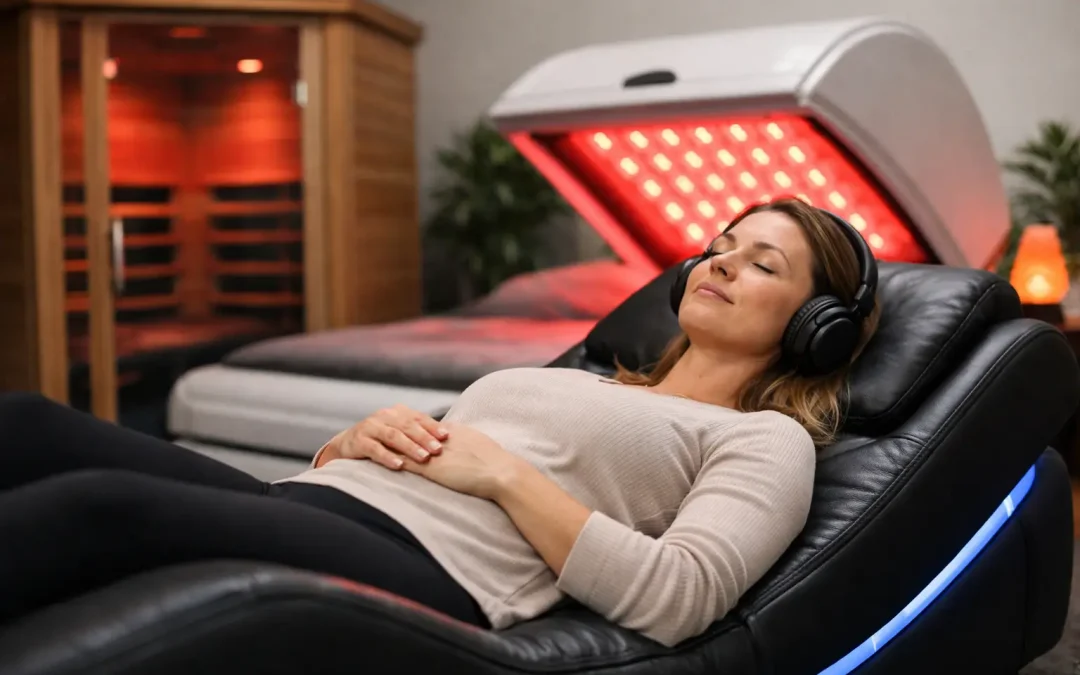
Vibroacoustic therapy uses low-frequency sound and vibration, typically experienced through a specialized mat, table, or chair. Rather than asking you to think your way out of stress, it offers sensory input your body can feel. The experience is often paired with music or sound designed to support rest, grounding, and a shift out of mental overdrive.
This approach is rooted in the principle of entrainment: the tendency of the body and brain to respond to steady rhythms. While responses differ from person to person, rhythmic vibration and calming sound may help create a felt sense of settling. Many people describe it as easier to relax when the work is happening around and through them, rather than relying on willpower alone.
Research into vibroacoustic therapy is still developing, but it has shown promise for relaxation, stress support, pain management, and quality of life in certain settings. It should not be presented as a cure or a replacement for medical or mental health care. Its value is in being a non-invasive, body-centered support that may help the nervous system access a calmer state.
At True You Collective, vibroacoustic therapy is part of a broader approach to full-body restoration. Light, sound, vibration, and heat can be thoughtfully combined to support the experience of slowing down, reconnecting, and giving your body a break from carrying everything alone.
Consistency changes more than intensity
A single calming session can feel wonderful, but lasting regulation usually comes from repetition. Think of it less like fixing a broken system and more like strengthening a relationship with your body. Each time you pause, breathe, receive supportive sensory input, or choose rest before reaching total depletion, you offer another signal that safety is possible.
Start small enough that you can actually continue. Two minutes of slow exhaling after work may be more powerful than a complicated routine you abandon after three days. A weekly restorative session may offer more than waiting until burnout forces you to stop. Your nervous system learns through what it experiences consistently.
It can also help to notice what regulation feels like for you personally. It may be a deeper breath, warmer hands, a softer jaw, fewer racing thoughts, a return of appetite, easier sleep, or simply the ability to be present with someone you love. Calm does not always arrive as bliss. Sometimes it arrives as the quiet realization that you have room to be yourself again.
When to seek additional support
Self-regulation practices can be meaningful, but they are not meant to carry the full weight of serious symptoms alone. If you are experiencing persistent panic, severe depression, thoughts of harming yourself, significant trauma symptoms, fainting, chest pain, new neurological symptoms, or a major decline in daily functioning, seek care from an appropriate licensed medical or mental health professional.
You deserve support that meets the depth of what you are carrying. Nervous system care can work alongside professional care, offering your body more moments of rest, capacity, and connection as you move forward.
Your body has been adapting for a reason. Meet it with patience, steady support, and the kind of care that helps it remember: even when life is still life, you can return to a place of greater calm within yourself.