Your body can look functional on the outside and still be running on alarm. You may be getting through work, answering texts, showing up for your family, even keeping up with healthy habits, while your system stays braced underneath it all. That is why non invasive therapy for chronic stress matters. It offers support that does not force, numb, or override the body. Instead, it helps the nervous system remember what safety feels like.
For many people, chronic stress is not just a mental state. It becomes physical. Sleep gets lighter. Muscles stay tight. Digestion changes. Focus drops. Patience disappears. You may feel tired and wired at the same time, or emotionally flat after months or years of pushing through. When stress becomes a pattern, the body often needs more than insight. It needs regulation.
Why chronic stress gets stuck in the body
Stress is designed to help you respond to a challenge. The problem begins when the challenge never fully ends. A high-pressure job, caregiving, grief, trauma, poor sleep, inflammation, pain, and constant digital stimulation can keep the nervous system in a loop of activation.
Over time, that loop starts to feel normal. You may think, this is just who I am now. But often what feels like your personality is really a protective state. Irritability, exhaustion, brain fog, shutdown, hypervigilance, and trouble resting can all be signs of nervous system dysregulation.
This is where a root-cause lens matters. If the nervous system is the foundation, then symptom relief alone may only go so far. You might get temporary improvement from a massage, a supplement, or a weekend off, then find yourself right back in the same pattern by Tuesday morning. Lasting change usually requires repetition, safety, and support that reaches the body directly.
What non invasive therapy for chronic stress actually means
Non invasive therapy for chronic stress refers to approaches that support healing without surgery, needles, medication, or aggressive intervention. In a wellness setting, this often includes therapies that use light, sound, vibration, and heat to help the body shift out of survival mode.
The goal is not to battle the body into relaxation. The goal is to create conditions where regulation can happen naturally. Science meets soul here. The body is given signals of safety, and from that place, it can begin to recalibrate.
That does not mean every modality works the same way for every person. Some people respond quickly to sound and vibration. Others need the grounding effect of heat or the cellular support of light. It depends on your stress load, your sensitivity, your history, and how depleted your system feels.
The therapies that often help most
Vibroacoustic therapy and nervous system entrainment
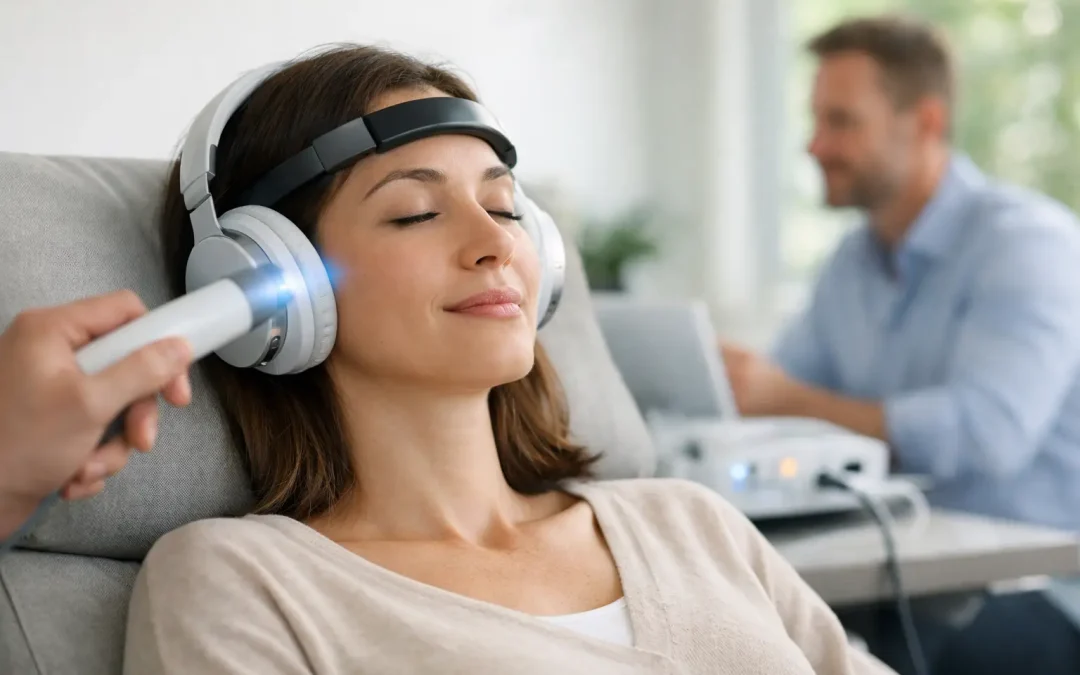
Vibroacoustic therapy is one of the most direct body-based tools for chronic stress because it works through frequency, resonance, and sound. When low frequencies move through the body, they can help guide the nervous system toward a more regulated state. This process is often described as entrainment. In simple terms, your body begins to synchronize with a calmer input.
That matters when your internal rhythm has been shaped by urgency for too long. Many people describe vibroacoustic therapy as the first time they have felt deeply relaxed without having to try. The experience can support a sense of being held, grounded, and internally quieter. It may also help with tension, sleep, emotional overwhelm, and the fatigue that comes from being constantly on guard.
Red light therapy for restoration
Stress is not only emotional. It affects inflammation, recovery, energy production, and how well the body repairs itself. Red light therapy is often used to support these deeper physiological processes. It offers a gentle, non-invasive way to encourage cellular restoration, which can be especially helpful when chronic stress has left you feeling worn down.
People are sometimes surprised by how much stress lives in the body as depletion. If your reserves are low, calming down can feel hard because your system does not have enough energy to shift states smoothly. Red light therapy can be a supportive piece of the puzzle for people who feel drained, inflamed, achy, or slow to recover.
Infrared sauna for releasing stored tension
Heat can be profoundly regulating when it is used with care. Infrared sauna supports circulation, relaxation, detoxification, and muscular release. For someone carrying chronic stress physically, heat can create a sense of softening that is difficult to access through willpower alone.
That said, more is not always better. If your system is already highly activated, heat can feel intense at first. A thoughtful approach matters. Shorter sessions, proper hydration, and tuning into your body can help make infrared sauna a restorative experience rather than an overstimulating one.
Multi-modality support for deeper reset
Sometimes the most effective care is not one therapy but a sequence of therapies working together. When vibration, light, sound, and heat are combined in an intentional way, the effects can feel more complete. One modality may help settle the mind, another may ease physical tension, and another may support recovery at the cellular level.
This is why immersive experiences can be so powerful for burnout and chronic stress. They do not just target one symptom. They speak to the whole system. At True You Collective, this kind of layered care is designed as a full-body nervous system reboot TM, helping clients move from overload into a more coherent, connected state.
What makes non invasive therapy different from coping
A lot of stress relief advice focuses on management. Take a walk. Breathe deeply. Journal. Meditate. These practices can be beautiful and genuinely helpful, but they are not always enough when your nervous system is stuck in a chronic pattern.
Non-invasive therapy can meet you in a different way because it is embodied. You do not have to think your way into safety. You do not have to be good at meditation. You do not have to explain everything you have been carrying. The body receives direct input through sensation, frequency, warmth, and rest.
That can be especially meaningful for people who are high functioning but exhausted, or for those who feel they have tried everything and still do not feel like themselves. Sometimes healing begins when the body finally has an experience of being supported rather than asked to keep performing.
How to know if this approach is right for you
If your stress feels constant, physical, or resistant to the usual self-care tools, a nervous system-based approach may be worth exploring. This can be true if you deal with burnout, poor sleep, chronic pain, emotional fatigue, grief, anxiety, or the sense that your body never fully powers down.
It is also a strong fit for people who want a gentler path. Non-invasive therapies can offer meaningful support without the intensity that some interventions bring. For many, that sense of safety is part of what allows healing to begin.
There are still trade-offs. These therapies are often most effective when they are done consistently, not just once in a while. Results can build over time. Some people feel immediate relief, while others notice subtler changes at first, like sleeping more deeply, recovering faster, or reacting less intensely to everyday stress. The process is personal.
Healing chronic stress is often about repetition
One of the biggest misunderstandings about regulation is the idea that one good session should fix everything. Chronic stress usually develops through repeated overload, so healing often happens through repeated experiences of safety. This is why ongoing care can matter more than a single breakthrough moment.
When the nervous system receives steady input that says you are safe now, it starts to trust that message. Your body remembers how to heal when it is given enough support, enough consistency, and enough room to come out of protection.
That is the deeper promise of this work. Not perfection. Not a life without stress. But a body that can respond without staying trapped there. A mind that can clear. A breath that can deepen. A version of you that feels more present, more resilient, and more like home.
If you have been carrying too much for too long, the answer may not be to push harder. It may be to let your nervous system be met in the language it understands best.