Sleep problems rarely begin at bedtime. More often, they start hours earlier in a body that never fully got the message that it was safe to come down from stress. That is why the best therapies for sleep and recovery do more than sedate the mind or force exhaustion. They help the nervous system shift out of survival mode so your body can remember how to rest, repair, and restore.
For many people, poor sleep is not just about being tired. It shows up as wired-but-drained evenings, frequent waking, shallow sleep, body tension, anxiety, pain, inflammation, and that heavy feeling of never quite catching up. If that sounds familiar, the question is not simply, “How do I sleep more?” It is, “What is keeping my system from receiving rest?”
What actually makes a therapy effective for sleep and recovery?
The most effective support usually works at the level of regulation. When your nervous system is stuck in overdrive, the body prioritizes protection over repair. Heart rate stays elevated. Muscles hold tension. Stress hormones remain active. Even if you are technically asleep, the quality of that sleep can be poor.
That is why the best therapies for sleep and recovery tend to share a few qualities. They calm the stress response, support circulation, reduce physical tension, and create conditions where healing becomes more available. Some also help with inflammation, pain, or mood regulation, which matters because sleep rarely exists in isolation.
There is no single best option for every person. It depends on what is disrupting your recovery. Someone dealing with burnout and emotional overwhelm may need a different entry point than someone with chronic pain or post-work stress. Still, a few therapies consistently stand out because they address the deeper patterns underneath restless sleep.
Vibroacoustic therapy for nervous system entrainment
If your mind is tired but your body still feels on alert, vibroacoustic therapy can be one of the most supportive places to begin. This modality uses low-frequency sound vibrations delivered through the body, often paired with music or carefully designed soundscapes, to guide the nervous system into a calmer state.
The reason it matters for sleep is simple. Many people cannot think their way into rest. The body needs a direct signal. Vibration gives that signal in a physical, embodied way. It helps interrupt stress loops, soften muscle guarding, and support a state of entrainment, where your internal rhythms begin to settle into a more regulated pattern.
This can be especially helpful for people who feel overstimulated, emotionally heavy, or disconnected from their bodies. Instead of asking you to try harder to relax, vibroacoustic therapy creates conditions where relaxation becomes easier to receive. Science meets soul here in a very real way. The experience can feel deeply grounding, but the effects are not just emotional. Better regulation often means better sleep onset, fewer nighttime wakeups, and more complete recovery over time.
Consistency matters. One session may help you exhale. Repeated sessions can help teach the body a new baseline.
Red light therapy for repair and rhythm
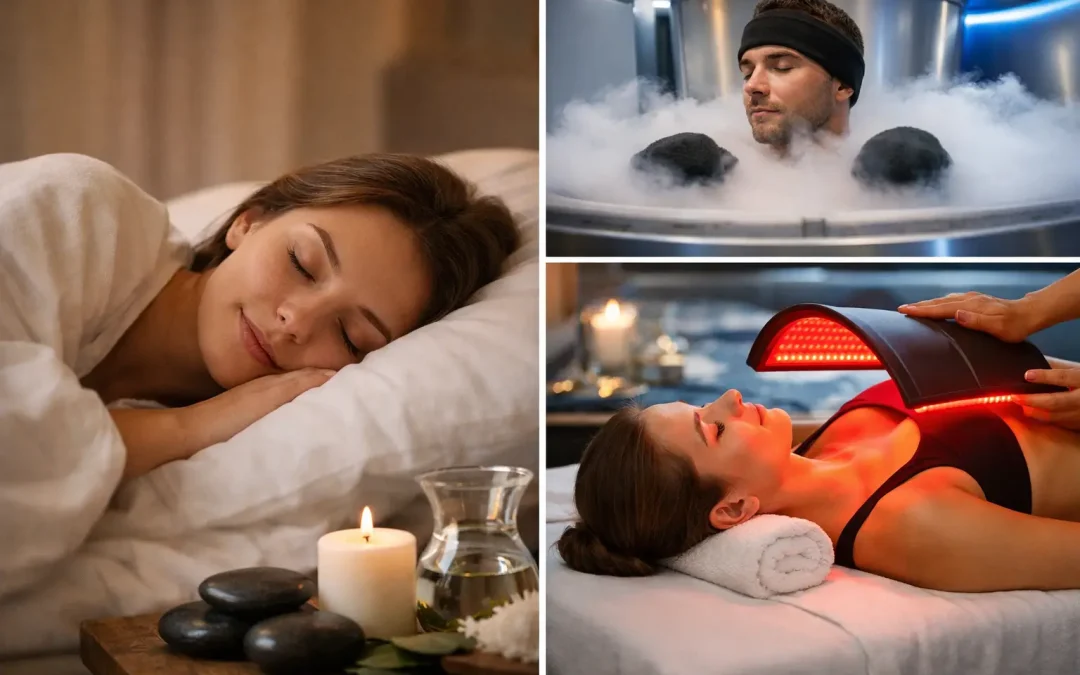
Red light therapy is often talked about in relation to skin, collagen, or performance, but it also has meaningful value for sleep and recovery. Light influences the body in profound ways, and specific wavelengths of red and near-infrared light are studied for their effects on cellular energy, tissue repair, and inflammation.
When recovery feels sluggish, this matters. A body dealing with inflammation, soreness, chronic stress, or physical depletion may struggle to settle into deep restorative sleep. Red light therapy supports the repair side of the equation. It can help the body do what it is already designed to do, but more efficiently.
There is also a timing piece. Exposure to the wrong kind of light at the wrong time, especially blue-heavy light late in the evening, can interfere with natural sleep rhythms. Red light is gentler and more evening-friendly, which makes it a useful support for people trying to create a more restorative pre-sleep environment.
It is not a knockout treatment. It is a recovery treatment. That distinction matters. Red light therapy is best for people who want to support the biological side of healing while also reducing the stressors that keep the nervous system activated.
Infrared sauna for deeper unwinding
Some people carry stress in thought loops. Others carry it in the body as tight shoulders, jaw tension, fatigue, inflammation, or the sense that they can never fully drop in. Infrared sauna can be powerful because it meets the body through warmth, circulation, and release.
Unlike a traditional sauna, infrared heat penetrates more directly and tends to feel more tolerable for people who want therapeutic warmth without an intensely oppressive environment. That heat helps increase circulation, encourage detox pathways, ease muscular tension, and support a parasympathetic shift after the session.
For sleep, the benefits are often indirect but meaningful. When the body feels less inflamed, less constricted, and less burdened by stress chemistry, it usually sleeps better. Many people also notice that infrared sauna creates a kind of full-body exhale. The mind gets quieter because the body is no longer shouting.
There are trade-offs, though. If you are depleted, heat-sensitive, or not properly hydrated, sauna may need to be approached gently. More is not always better. Recovery work should feel supportive, not depleting.
Multi-modality experiences often work better than one-off fixes
Sleep and recovery challenges rarely come from a single source, which is why layered care can be so effective. If you are dealing with stress, inflammation, emotional fatigue, and poor sleep all at once, one modality may help, but a more integrated approach often helps more.
A multi-modality session that combines vibration, light, and heat can support several systems at the same time. One therapy may calm the nervous system. Another may improve cellular recovery. Another may reduce tension and improve circulation. Together, they create a deeper reset than any single tool can always provide on its own.
This is often where people feel the difference between symptom management and root-cause support. You are not just trying to knock yourself out at night. You are helping your entire system recalibrate so sleep can happen more naturally.
For someone in burnout, grief, chronic stress, or high-demand work, this matters. The body often needs more than a quick fix. It needs repetition, safety, and enough support to come out of defense.
How to choose the right therapy for your body
If your main issue is feeling wired, anxious, or unable to settle, start with therapies that directly regulate the nervous system, especially vibroacoustic support. If pain, inflammation, or physical recovery is keeping you awake, red light therapy and infrared sauna may offer stronger support. If you feel like everything is off at once, energy, mood, sleep, tension, overwhelm, then integrated care is usually the more honest answer.
It is also worth paying attention to how you want to feel, not just what you want to stop feeling. Do you want deeper sleep? A calmer evening body? Fewer 3 a.m. wakeups? Less pain? More emotional steadiness? Better recovery after intense work or training? The right therapy is often the one that matches both your symptoms and your healing capacity.
A good practitioner will help you pace this well. Some nervous systems need gentle consistency more than intensity. Others respond beautifully to immersive sessions that provide a stronger reset. It depends on your current load, your sensitivity, and how long your system has been running on empty.
Why sleep gets better when the body feels safe
One of the biggest shifts people experience is realizing that rest is not just a habit. It is a state of permission. When your system has been bracing for too long, sleep can feel strangely out of reach even when you are exhausted.
This is why therapies centered on regulation are so powerful. They do not ask you to override your body. They help you listen to it, support it, and gently guide it back toward balance. That is the deeper promise of restorative care. Your body remembers how to heal when it is given the right conditions.
At True You Collective, that belief sits at the center of the work. Science-backed tools like vibroacoustic therapy, red light therapy, infrared sauna, and immersive reset experiences can help bring the body back into coherence so recovery stops feeling so far away.
If sleep has become another source of stress, start smaller than you think. Start with the nervous system. Start with safety. Start with support your body can actually receive. Sometimes the path back to deep rest is not about doing more. It is about creating enough calm for healing to finally begin.