
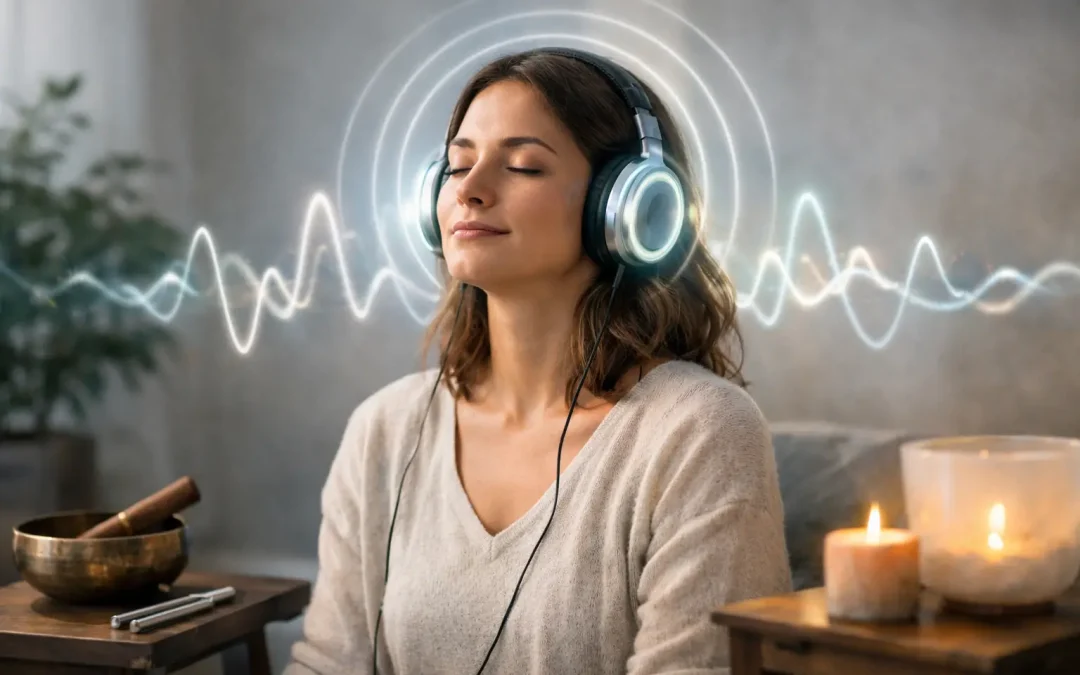
Some stress lives in your thoughts. Some stress lives in your body long after the stressful moment has passed. You may know exactly why you feel overwhelmed, and still find that your chest stays tight, your sleep stays broken, and your mind never fully settles. That is where frequency healing for stress starts to make sense – not as a trend, but as a way to help the nervous system remember safety.
For many people, stress is not just mental pressure. It is a whole-body state of dysregulation. Your system can get so used to bracing, pushing, and surviving that calm begins to feel unfamiliar. When that happens, talk-based solutions and basic self-care may help, but they do not always reach the deeper patterns held in the body. Sound, vibration, light, and heat-based therapies can support a different kind of shift. Science meets soul here, and the goal is simple: help your body move out of fight-or-flight and back into regulation.
What frequency healing for stress actually means
Frequency healing is an umbrella term for therapies that use measurable energetic inputs – often sound frequencies, vibration, light wavelengths, or rhythmic pulses – to influence how the body feels and functions. In a wellness setting, this usually does not mean chasing a miracle frequency that fixes everything. It means using targeted sensory input to create conditions where the body can soften, regulate, and heal.
The most grounded way to understand it is through the nervous system. Your brain and body are always taking in signals from the environment. Some signals tell you to stay alert. Others tell you it is safe to rest. Frequency-based therapies work by offering calming, rhythmic, and consistent input that can help interrupt stress patterns and encourage a more regulated state.
One of the key ideas behind this work is entrainment. Entrainment is the process by which the body begins to synchronize with an external rhythm. If your internal state feels chaotic, scattered, or depleted, steady therapeutic frequencies may help guide the system toward greater balance. That does not mean every session feels dramatic. Sometimes the first sign is subtle – deeper breathing, unclenched muscles, a quieter mind, or the first good nap you have had in weeks.
Why stress responds to vibration, sound, and rhythm
Stress changes more than mood. It affects heart rate, muscle tension, digestion, sleep cycles, hormone output, and pain sensitivity. Over time, that can create a loop where the body keeps acting stressed even when the immediate crisis is over.
This is why rhythm matters. The nervous system likes predictability. It responds to repetition. Gentle vibration, low-frequency sound, and soothing sensory environments can create a felt experience of support rather than demand. Instead of asking your mind to force relaxation, these therapies help the body experience it directly.
That difference matters for people dealing with burnout, grief, chronic pain, emotional fatigue, or high-functioning anxiety. If you are used to pushing through, you may be very good at appearing fine while your system is still in overdrive. Frequency-based care offers another path. It meets you where words often cannot.
Vibroacoustic therapy and stress relief
When people talk about frequency healing for stress, vibroacoustic therapy is often one of the most tangible examples. In this modality, therapeutic sound frequencies are delivered through the body as vibration while you rest. You are not just hearing sound. You are feeling it.
This can be especially supportive for people who struggle to meditate, settle their thoughts, or fully relax on command. The body receives the frequencies first. As muscles begin to release and the breath slows, the mind often follows.
Vibroacoustic therapy is compelling because it speaks both the language of science and the language of felt healing. On one side, there is growing interest in how low-frequency sound and vibration may support relaxation, circulation, pain relief, and nervous system regulation. On the other, there is the lived experience so many people describe after a session: I feel lighter. I feel grounded. I feel like myself again.
It is not uncommon for stress to be layered with other issues like inflammation, disrupted sleep, or chronic tension. That is where this modality can feel especially restorative. By helping regulate the nervous system, it may also support the systems stress has been straining.
What results are realistic?
This is where nuance matters. Frequency healing is not a one-size-fits-all fix, and it is not a substitute for medical or mental health care when deeper treatment is needed. Some people feel a noticeable shift after one session. Others need repetition before their body trusts enough to let go.
A lot depends on how long stress has been building, how dysregulated the nervous system has become, and whether other factors are involved, such as trauma, hormone imbalance, pain, or sleep deprivation. If your body has been in survival mode for years, it may take time to create a new baseline.
Still, many people begin with simple changes. They sleep more deeply. They stop waking up clenched. Their thoughts feel less scattered. They feel less reactive and more present. These may sound small, but when stress has been running your life, they are not small at all. They are signs that your body remembers how to heal.
Frequency healing works best as part of a bigger regulation practice
The most lasting results usually come from integration, not one-off sessions. Stress patterns are repetitive, so healing often needs repetition too. Regular nervous system support gives the body more chances to practice safety, rest, and recovery until those states become more familiar.
That is also why frequency-based therapies often pair well with other modalities. Red light therapy may support recovery and inflammation. Infrared sauna sessions may help the body release tension and settle into deeper rest. Breathwork, hydration, walking, and sleep support can all reinforce what happens during a session.
For some people, a multi-modality experience is where everything clicks. The combination of sound, vibration, heat, and light can create a full-body reset that feels more complete than any single tool on its own. At True You Collective, this nervous system-first approach is designed to help clients move beyond symptom management and into deeper restoration.
Is frequency healing for stress right for everyone?
Not always in the same way, and not always at the same pace. Some people love the sensory experience right away. Others need gentler exposure, especially if their system is highly sensitive or they are not used to stillness. Occasionally, the first session reveals just how tired the body really is, which can feel emotional as much as physical.
That does not mean something is wrong. It often means the body is finally getting space to downshift. But the right setting matters. Supportive guidance, clear expectations, and therapies delivered with care make a real difference.
If you are curious but skeptical, that is okay too. You do not have to believe in anything mystical to benefit from nervous system regulation. You simply need a body that has been carrying too much for too long. Frequency-based wellness can be deeply experiential, and sometimes the body understands before the mind does.
What to look for in a frequency-based stress practice
Look for a practice that can explain what it does in plain language without overpromising. The best providers do not rely on hype. They understand both the physiology of stress and the reality that healing is personal.
You also want an environment that feels safe enough for your body to soften. That includes the technology, but it also includes the human element. Feeling seen, supported, and unrushed is part of the medicine. Stress often comes with disconnection from self, so the healing experience should help you reconnect, not just consume another service.
If you have tried everything and still feel stuck, that does not mean you are failing. It may mean your nervous system needs a different conversation. One that uses rhythm instead of pressure. One that helps you recalibrate from the inside out.
There is something deeply hopeful about that. Even after burnout, grief, chronic stress, or long periods of survival mode, the body can respond to care. Sometimes it begins with a frequency you can feel, a breath you did not have to force, and the quiet realization that calm is still available to you.