
If you have been sleeping but never feeling rested, reacting faster than you mean to, carrying tension that will not leave your shoulders, or feeling wired and exhausted at the same time, your body may be asking for regulation before anything else. When people ask how to heal nervous system dysregulation, they are often really asking a deeper question: why does my body not feel safe enough to settle, even when I want it to?
That question matters because dysregulation is not just stress in your mind. It is a full-body state. Your heart rate, muscles, digestion, hormones, mood, pain levels, sleep quality, focus, and emotional capacity are all shaped by the nervous system. When that system has been under pressure for too long, whether from burnout, grief, trauma, chronic pain, inflammation, poor sleep, or ongoing emotional strain, the body can forget how to come back to center.
The good news is that your body remembers how to heal. It often just needs the right inputs, repeated consistently, to find its way back.
What healing nervous system dysregulation really means
Healing does not mean you never feel stress again. A healthy nervous system is not flat or numb. It is flexible. It can rise to meet life, then come back down. It can move through challenge without getting stuck in overdrive or collapse.
That is why healing nervous system dysregulation is less about forcing yourself to calm down and more about building regulation capacity. You are teaching your system that safety is possible again. Sometimes that happens through quiet practices like breathwork or meditation. Sometimes it happens through body-based therapies that help the body settle faster than the mind can talk it through.
This is where people often feel relieved. They realize they are not failing at healing. Their body may simply need support that reaches deeper than willpower.
Why the body can get stuck
The nervous system is designed to protect you. When life feels overwhelming, it adapts. It may shift into fight or flight, where anxiety, tension, racing thoughts, irritability, shallow breathing, and sleep disruption show up. Or it may move toward shutdown, where fatigue, numbness, brain fog, depression, disconnection, and low motivation take over.
Many people move between both. They feel activated all day and depleted at night. They push through work, caregiving, grief, or chronic discomfort until their body stops cooperating. This is not weakness. It is an intelligent survival response that has stayed switched on for too long.
The challenge is that once dysregulation becomes familiar, the body can start treating it as normal. That is why healing usually takes more than one good night of sleep or one relaxing session. The nervous system responds to repetition, rhythm, and experiences of safety that are felt in the body.
How to heal nervous system dysregulation in a way that lasts
If you want lasting change, it helps to think in layers rather than quick fixes. The most effective healing is usually gentle, consistent, and embodied.
Start with safety, not self-judgment
Many people try to heal while still talking to themselves in a harsh voice. They are frustrated that they cannot focus, rest, relax, or bounce back. But healing begins when the body senses less internal threat.
That can look very simple. Slower mornings. Fewer stimulants if your system is already revved up. More predictable routines. Nourishing food at regular times. Less multitasking. More pauses between demands. None of this is glamorous, but it creates a steadier baseline.
If your system is deeply dysregulated, even traditional self-care can feel like one more thing to do. That does not mean you are doing it wrong. It may mean your body needs more direct support.
Use bottom-up tools, not just top-down tools
Mindset work matters, but the nervous system does not always respond to logic when it is in survival mode. This is why body-based healing can be so powerful. Bottom-up approaches work through sensation, frequency, temperature, breath, and vibration to help the body shift states.
Practices like breathwork, restorative yoga, walking, humming, EFT, and meditation can all help. So can science-backed wellness modalities that create a stronger sensory signal of safety and regulation.
Vibroacoustic therapy is especially promising here because it works through sound and vibration delivered directly to the body. These low-frequency vibrations can support entrainment, which is the process of the body syncing with calming rhythmic input. For many people, that means the mind stops racing, the muscles begin to release, and the nervous system gets a felt experience of settling instead of just trying to think its way there.
That matters because regulation is not only a concept. It is an experience your body learns through repetition.
Support the body with restorative inputs
When the nervous system is overloaded, the body often benefits from therapies that reduce stress load and support recovery at the same time. This is where light, heat, and sound-based therapies can complement foundational lifestyle shifts.
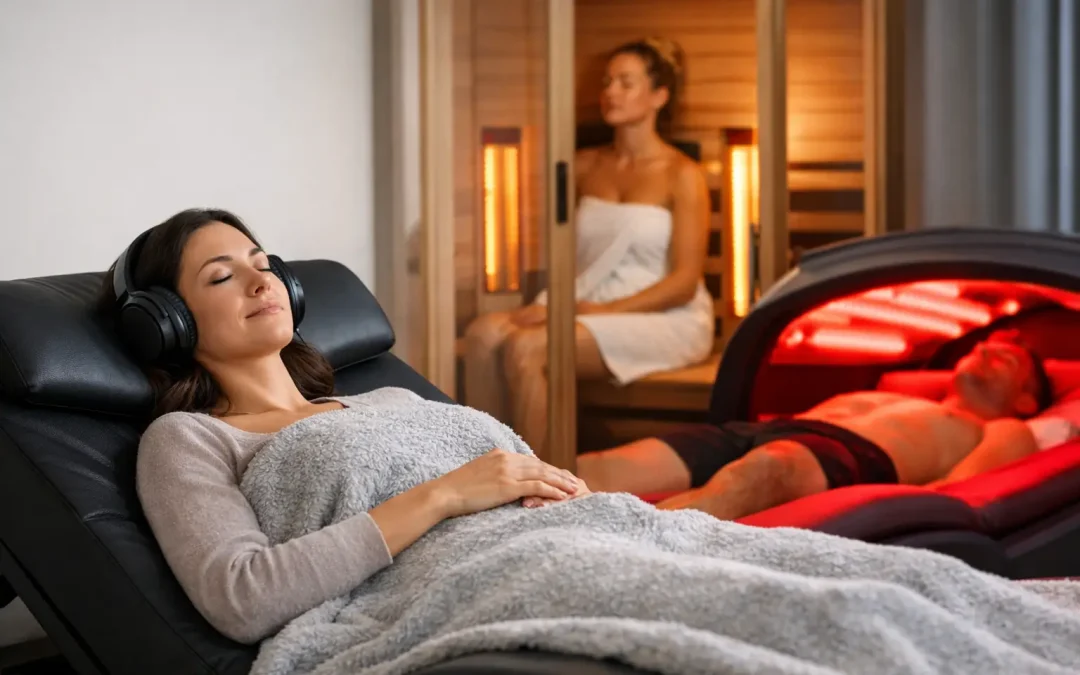
Red light therapy is often used to support cellular repair, reduce inflammation, and promote recovery. Infrared sauna sessions can encourage relaxation, circulation, and a deeper unwinding response, especially for people who carry stress physically. Combined thoughtfully, these approaches can help the body move out of chronic bracing and into a more restorative state.
Some people respond best to one modality at a time. Others feel the most change when several supportive inputs are layered together. It depends on your sensitivity, your symptoms, and how depleted your system is.
Signs your nervous system is starting to heal
Healing is not always dramatic at first. Often it shows up quietly.
You may notice you recover faster after stress. You sleep a little deeper. You stop startling as easily. Your thoughts feel less noisy. Pain softens around the edges. Digestion becomes more regular. You feel less reactive, less numb, or more present with the people you love.
For some, the first sign is emotional. They cry during a session or suddenly feel how tired they have been. That is not a setback. It can be a sign that the body is finally safe enough to release what it has been holding.
This is one reason nervous system healing asks for patience. Progress is rarely perfectly linear. Some weeks feel open and grounded. Others feel tender. What matters most is the overall direction.
What can slow the healing process
Trying to do everything at once can backfire. If you are pushing hard in every area of life while adding five new wellness practices, your system may feel more overwhelmed, not less. Gentle consistency usually works better than intensity.
It also helps to be honest about what is still keeping your body on alert. That could be chronic overwork, unresolved grief, relationship stress, inflammatory habits, poor boundaries, or a lifestyle that never allows enough recovery. Healing does not always require changing everything overnight, but it does ask for truth.
And while education is helpful, healing is not the same as collecting information. Many people understand nervous system regulation intellectually but still do not feel regulated. That gap is where embodied support becomes essential.
When professional support makes sense
If your symptoms are persistent, intense, or interfering with daily life, having skilled support can make the process feel safer and more effective. Sometimes the body needs an environment designed for regulation, where you do not have to generate the calm all by yourself.
At True You Collective, this is the heart of the work: helping people reconnect to a regulated state through science-backed, body-based therapies that support the nervous system at the root. For many in Arvada and the greater Denver area, that kind of care feels different because it is not about pushing through symptoms. It is about giving the body the conditions it needs to remember balance.
There is no single correct path for everyone. Some people need daily nervous system practices at home. Some need deeper therapeutic support. Most benefit from both. The key is choosing methods that help your body feel safe, supported, and gently guided back into rhythm.
A more honest answer to how to heal nervous system dysregulation
If you were hoping for one perfect trick, this may feel less tidy than you wanted. But it is more true. Healing usually happens through repeated experiences of safety, regulation, and restoration. It happens when the body is no longer asked to survive every moment alone.
You do not need to force healing. You need to create the conditions for it. Science meets soul there – in the quiet rebuilding of trust between you and your body, one regulated moment at a time.