
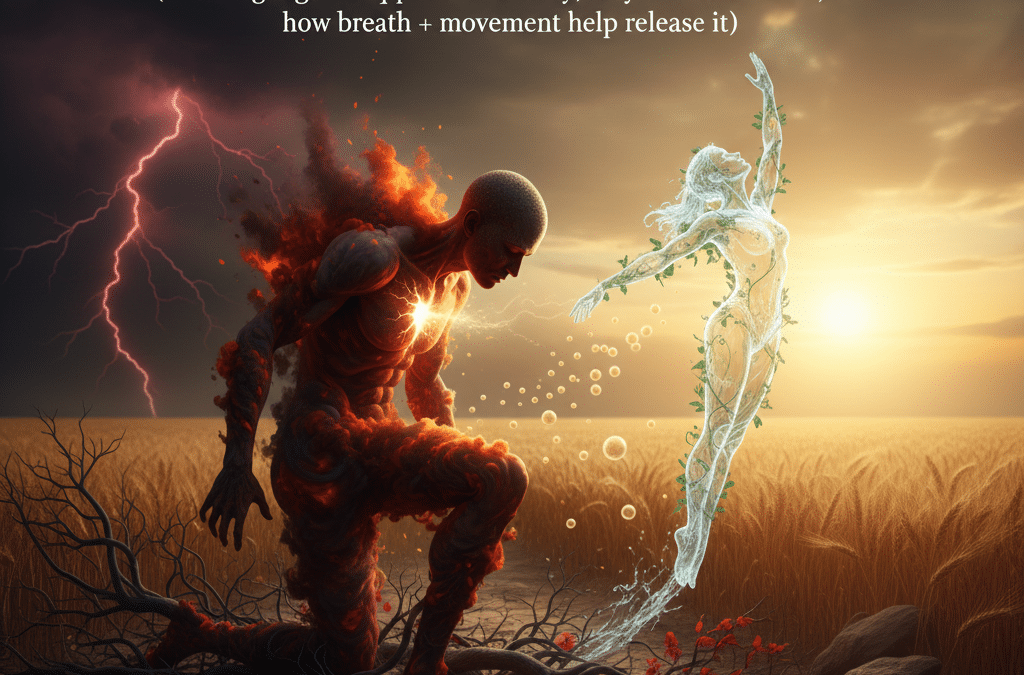
(How anger gets trapped in the body, why we misdirect it, and how breath + movement help release it)
Most people don’t think of themselves as angry.
We say things like:
“I’m just irritated.”
“I’m overwhelmed.”
“That person cut me off—I had a right to be mad.”
“I don’t get angry, I just shut down.”
But anger is rarely about the moment in front of us.
Anger is a nervous system response—a survival signal that has been stuck on replay for years, sometimes decades.
And when we don’t understand its root, anger becomes the lens through which we move through life… even when we swear we’re “fine.”
Anger Begins in the Body Long Before It Reaches the Mind
We’re not born angry.
Anger is learned, shaped, conditioned, stored, and repeated.
Biologically, anger is simply activation—a sympathetic surge meant to protect you:
- Something feels threatening
- Your heart rate increases
- Muscles tighten
- Breath shortens
- The body prepares to fight
This is useful when danger is real.
But when you live in chronic stress, unresolved grief, or emotional overload, the nervous system begins to misfire.
Anger becomes a habitual response instead of an accurate one.
And here’s the deeper truth:
Anger is almost always a messenger for something underneath.
Hurt.
Fear.
Abandonment.
Being overstimulated.
Being unheard.
Being overwhelmed.
Being disconnected from your body.
Anger is the smoke.
Something older is the fire.
Why We Misplace Anger on the Wrong People at the Wrong Times
When anger doesn’t have a healthy pathway out, it doesn’t disappear.
It hides.
In your jaw.
In your gut.
In your chest.
In the way you brace for impact.
In the tension that never fully dissolves.
This is why tiny things feel huge—
the traffic snarl, the comment from a coworker, the forgotten text, the dishes in the sink.
You’re not reacting to that moment.
You’re reacting to every moment you suppressed before it.
Unreleased anger will always erupt sideways:
- snapping at people you love
- withdrawing without explanation
- quitting things before you commit
- avoiding conflict at all costs
- choosing not to hurt others but hurting yourself instead
- or blasting anger unexpectedly, confusing everyone including you
Anger that isn’t metabolized doesn’t vanish—
it reroutes.
And everyone suffers:
those around you, your relationships, your clarity, your body, and your ability to fully experience life.
Trapped Anger Traps You in Your Body
When anger stays unprocessed, it becomes a physical imprint.
Research now shows:
- Chronic anger increases cortisol and inflammatory markers
- The amygdala becomes more reactive and fires faster
- Vagal tone decreases, lowering emotional regulation
- Muscles tighten and stay braced, even at rest
- The prefrontal cortex (logic, empathy, patience) shuts down
This is why people say, “I feel stuck.”
You’re not stuck in life—you’re stuck in physiology.
Your body is holding old activation and cycling it without release.
This is why nervous system work feels like liberation:
When the body loosens, the story loosens.
When breath deepens, anger softens.
When movement returns, trapped emotion can finally move too.
Breath + Movement: The Two Tools Anger Responds to Instantly
Anger is physical—so the release must be physical.
**1. Breath:
Anger blocks the breath. Breath dissolves the block.**
A simple tool:
Inhale for 4
Hold for 2
Exhale for 8
This long exhale signals the vagus nerve: We’re safe now.
Within a minute, the sympathetic spike begins to settle.
Anger cannot survive a long exhale.
It needs urgency to exist.
**2. Movement:
Anger is trapped energy that needs somewhere to go.**
Not aggressive movement—intentional movement.
Try:
- shaking your hands
- stomping your feet gently
- swaying your body
- stretching your sides and ribs
- rolling your shoulders back and down
- humming or vocal toning
- placing pressure through your feet into the ground
Movement gives anger a pathway out instead of letting it ricochet inside you.
This is why modalities at True You Collective—vibroacoustic therapy, infrared heat, red light—are so supportive.
They quiet the physiological tension that anger clings to.
The calmer the body, the clearer the root becomes.
**You Are Not Meant to Live in Anger.
You’re Meant to Move Through It.**
Anger is not a flaw.
It’s not a problem to be fixed.
It’s not a personality.
Anger is a nervous system signal asking for release, breath, movement, safety, and understanding.
And when you begin responding to it with compassion instead of self-judgment, something powerful happens:
Your body softens.
Your relationships stabilize.
Your reactions become choices.
Your intuition strengthens.
Your life opens again.
You return from survival into presence.
Back into observing, experiencing, and embracing the world rather than bracing against it.
Anger stops being your home and becomes what it was always meant to be:
a doorway back to yourself.