
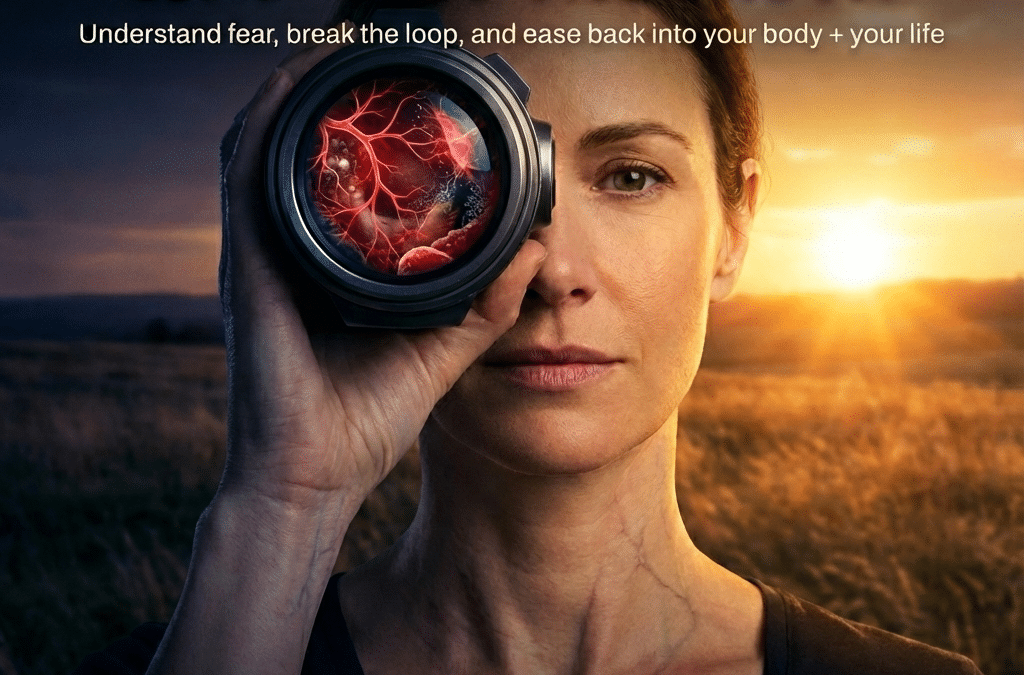
(Understand fear, break the loop, and ease back into your body + your life)
We spend so much of our lives believing fear is a personality trait.
“I’m just anxious.”
“I overthink everything.”
“I stay at jobs I hate because it feels safer than the unknown.”
But the truth is far more biological than personal.
When your nervous system is overloaded—stuck in chronic fight-or-flight—fear becomes the soundtrack behind everything. The world starts to feel unsafe not because it is, but because your body can’t exit the survival loop long enough to remember otherwise.
This isn’t failure.
This isn’t weakness.
This is physiology.
The Fear Loop: When Biology Hijacks Your Life
Your nervous system has one primary job: keep you alive.
When it senses danger (real or perceived), it flips a switch:
- Heart rate rises
- Muscles tense
- Digestion slows
- Your mind scans for worst-case scenarios
- You lose access to creativity, clarity, intuition, and long-term decision-making
This is brilliant for emergencies.
But not for everyday life.
When the switch gets stuck “on,” your body begins to misinterpret everything as a threat—jobs, relationships, choices, conversations, opportunities.
Fear becomes the default narrator, even when nothing dangerous is happening.
Modern research now confirms this:
- Chronic stress causes the amygdala (fear center) to enlarge and fire more often
- The prefrontal cortex (logic + decision-making) becomes less active
- Vagus nerve signaling decreases, weakening feelings of safety
- Cortisol stays elevated, keeping your system primed for danger
In this state, fear isn’t intuitive wisdom—it’s malfunction.
Your body isn’t telling the truth.
It’s telling an old story.
Why We Stay in Jobs, Relationships, and Versions of Ourselves That Don’t Serve Us
Fear convinces us that staying uncomfortable is safer than risking the unknown.
In nervous system overload, the subconscious whispers:
- “Don’t leave that job—you won’t survive.”
- “Don’t set that boundary—it’s not safe.”
- “Don’t try something new—you’ll fail.”
- “Stay small—it’s safer.”
This fear masquerades as logic.
But it’s survival physiology dressed up as practicality.
When your body doesn’t feel safe, no decision feels safe.
Fear becomes a deterrent for most, even though its original purpose was meant to motivate action.
Instead of moving us forward, it freezes us in place.
Fear Is a Lie… Until Safety Is Restored
The biggest breakthrough many people have is realizing this:
Fear feels true when your body is overwhelmed.
But once your system calms, the message changes.
This is why people leave toxic jobs after a retreat.
It’s why clarity arrives after breathwork or red light therapy.
It’s why vibroacoustic sound can unlock choices you’ve been avoiding.
When your nervous system feels safe, the real you comes back online.
You stop reacting.
You start remembering who you are.
**So How Do You Break the Loop?
Small shifts. Embodied safety. Tiny moments of regulation.**
Here are practical, doable ways to ease out of fear and back into yourself:
1. Feel Your Body Before You Try to Fix Your Life
Fear pulls you into your mind.
Safety brings you back into the body.
Try this:
Put one hand on your chest and one on your belly.
Breathe slowly into the lowest hand.
Your vagus nerve recognizes this pattern as safety.
Within 90 seconds, the fear signal begins to soften.
2. Interrupt the Thought Spiral with Sensation
Instead of arguing with your brain, give your body an anchor:
- Cold water on your wrists
- A weighted blanket
- Gentle humming
- Rocking back and forth
- Touching something textured
These tactile inputs signal to your nervous system: We're here. We're safe.
3. Red Light, Infrared Heat, and Vibroacoustics
Science-backed modalities help shift the body out of sympathetic overdrive:
- Vibroacoustic sound calms the amygdala and increases vagal tone
- Red light therapy supports cellular repair and stress reduction
- Infrared sauna decreases cortisol and increases parasympathetic activation
This is why at True You Collective we layer them—
because the body responds faster when it feels supported from multiple directions.
4. Question Fear After Your Body Softens—not before
Ask yourself:
Is this fear true, or is this fear coming from exhaustion?
The body will answer differently when it’s regulated.
5. Choose One Tiny Brave Thing Daily
Fear loses power when you build evidence that you can move through it.
A brave thing can be small:
- Send the email
- Say no
- Say yes
- Rest when you feel guilty
- Walk away from something draining
These micro-moves build safety from the inside out.
6. Remember: You’re Not Meant to Do This Stuck in Your Head
Your nervous system was designed to co-regulate with sound, light, temperature, breath, community, and rest.
You don’t “think” your way out of fear.
You reboot your system so the fear no longer runs the show.
Where You Go From Here
When you begin shifting out of overload, the world doesn’t just look different—it feels different.
Fear becomes a messenger, not a dictator.
Your choices feel wider.
Possibility returns.
Your intuition gets louder.
Your life starts to fit again.
And slowly, you realize:
You were never broken.
You were overloaded.
And overload can be unwound.
One breath, one moment, one nervous system reboot at a time. 💙✨